Apples, this sweet and delicious fruit, always give a satisfying and crisp taste when lightly bitten. Do you also love this fruit deeply? Do you long to be able to taste the fresh apple flavor at home? There are various varieties of apples, each with its own unique color and shape of leaves and flowers. Its leaf shapes vary from elliptical to broadly elliptical, with leaf colors gradually changing from yellow green to dark green, and the edges decorated with rounded and blunt serrations. The flowers are presented in umbels, each containing 3 to 8 petals with a diameter of about 2-4 centimeters. The color varies depending on the variety, such as white, light pink, or carmine, and the flowering period is usually concentrated in March April. Bonsai Apple Tree also have bright flowers and diverse tree crown shapes, making them a beloved plant landscape for many people.

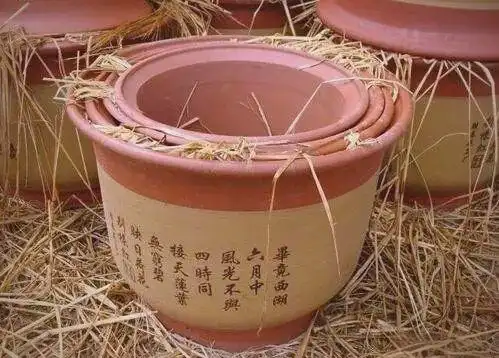
011. When choosing Bonsai Apple Tree, priority should be given to varieties with compact tree crowns, slender branches, slightly smaller leaves, and graceful postures. At the same time, it is necessary to select apple trees with strong sprouting ability, early fruiting, continuous high yield, long fruiting period, and strong disease resistance and adaptability to potted environments. For example, varieties such as Yi Nv, Dong Hong Guo, and Rose Red are all good choices.
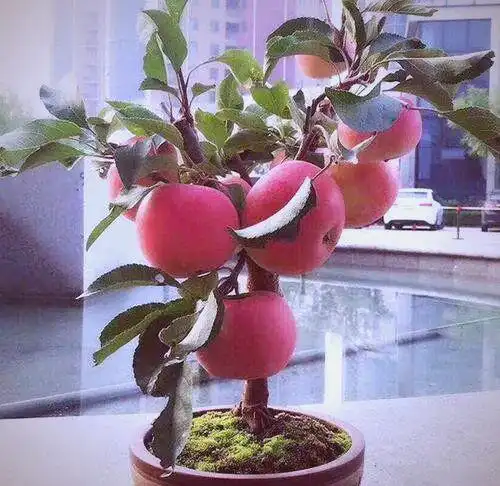 △ 1.1 Winter Red Fruit
Winter red fruit is also a good choice. It has the characteristics of compact crown, slender branches, small and beautiful leaves, strong sprouting ability, early fruiting, continuous high yield, and strong disease resistance and adaptability to potted environments.
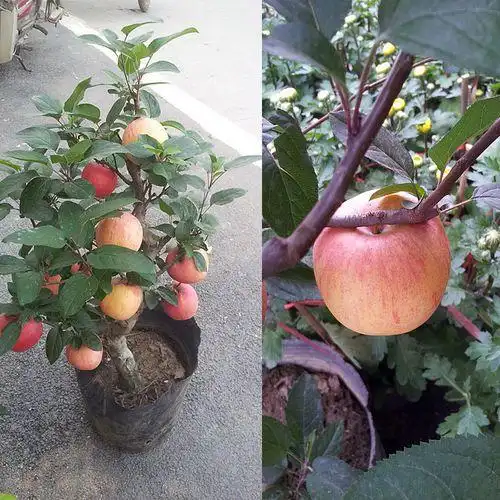 △ 1.2 Rose Red
Among many potted apple varieties, rose red fruit is also a recommended option. Its bright color is like a blooming rose, eye-catching. At the same time, it also has the characteristics of vigorous growth, abundant fruiting, and strong disease resistance.
022. Pot and soil configuration for apple potted plants
When choosing a container for Bonsai Apple Tree, we need to pay attention to the material, size, and breathability of the pot.
. Meanwhile, configuring nutrient soil is also a crucial step, as it directly affects the growth and fruiting of apple trees. Nutritious soil should be rich in organic matter, have good water retention and breathability, and provide necessary growth conditions for red bell fruit. △ 2.1 Selection of pots for Bonsai Apple TreeWhen Bonsai Apple Tree, it is recommended to prioritize using vegetarian pots or purple clay pots.
. These two types of pots have good breathability and are beneficial for the root growth of apple trees. At the same time, they also have a certain degree of aesthetics and can form a harmonious combination with apple trees. △ 2.1.1 Pottery specificationsPottery made of other materials, such as wooden pots, usually have a diameter of about 40cm, a bottom diameter of about 35cm, a height of 30cm, and are mainly circular.
. This shaped pot design helps the apple tree's roots to spread evenly in all directions, thereby promoting its healthy growth. The preparation of nutrient soil is crucial as it directly affects the growth of apple trees. The ideal nutrient soil should have excellent physical and chemical properties, rich humus, strong nutrient retention capacity, good water storage, smooth ventilation, and suitable acidity and alkalinity. To meet these requirements, typically 6 parts of fertile mature soil, 2 parts of river sand, 1 part of decomposed sheep manure, and 1 part of composted leaves and horsefoot fermented fertilizer are mixed and sieved. After preparation, the culture soil should be disinfected by steaming, baking, or drug treatment, and its pH should be measured and adjusted to ensure that apple trees grow within the appropriate pH range of 5.7-6.7.
 033. Steps and Techniques for Apple Planting
Pouring is an important step in apple tree planting.
. It is usually chosen to plant before sprouting in spring or after falling leaves in autumn, which is more conducive to the growth of apple trees. During the planting process, the roots should be disinfected by soaking them in a 5-degree stone sulfur mixture, and necrotic and excessively long roots should be cut off. Next, place several broken tiles at the bottom of the basin and lay a 2-3cm thick layer of slag as a drainage layer. Afterwards, add 1/3 of the cultivation soil and evenly arrange the roots of the apple tree. Gently shake the seedlings while filling the soil to ensure that the roots are tightly integrated with the soil. After the filling is completed, the soil should be compacted and watered thoroughly to maintain its moist state.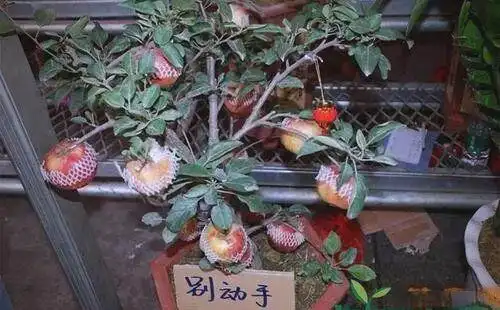
044. Scientific fertilization and watering
The growth of apple trees cannot be separated from reasonable fertilizer and water management. In terms of fertilization, the principle of "moderate, balanced, and long-term" should be followed, and organic fertilizers, phosphorus and potassium fertilizers, etc. should be applied in a timely manner according to the growth stage and needs of apple trees. At the same time, attention should be paid to the method of fertilization to avoid excessive or insufficient fertilization, so as not to affect the health of apple trees. In terms of watering, it is necessary to flexibly control according to the season, weather, and soil conditions, keep the soil moist but not too wet, and ensure that apple trees can grow normally and bear high-quality fruits.
△ 4.1 Fertilization Strategy for Apple BonsaiFertilization is a crucial step in maintaining apple bonsai.
. We need to follow the principle of "thin fertilization, frequent application, and balanced nutrition" to ensure that plants receive the necessary nutrients. According to different growth stages, we need to flexibly adjust the fertilization plan to provide appropriate nutrient support.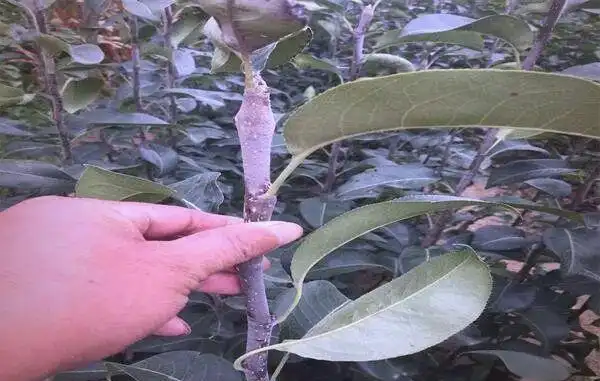 △ 4.2 Watering Points for Bonsai Apple Tree
The soil of Bonsai Apple Tree should be thoroughly watered after it has dried thoroughly to ensure sufficient water supply during the germination, flowering, and fruit swelling periods. In June, to promote flower bud differentiation, watering should be appropriately controlled, while during the rainy season from July to August, watering frequency should be reduced.
055. The shaping and pruning methods of apple bonsai
The shaping and pruning of potted apple trees are crucial.
. According to the specific situation of the seedlings, they can be cultivated into various shapes such as natural round head shape, tower shape, etc. Pruning should be determined according to the specific situation of the seedlings, to maintain the ventilation and transparency of the tree shape and promote fruiting. △ 5.1 Pruning MethodDuring plastic pruning, attention should be paid to the angle opening to facilitate the formation of flower buds and achieve high yield.
. Pruning of the fruiting tree should be carried out after dormancy, with appropriate thinning of some fruiting branches to balance tree vigor and expand the crown. 066. Flower and fruit management and pest controlProper arrangement and bagging of flowers and fruits, as well as strengthened monitoring and control of pests and diseases, are important parts of potted apple management to produce high-quality apples.
. Before flowering, sufficient nutrient supply should be ensured to promote the normal opening of flowers, and through reasonable flower and fruit management, Bonsai Apple Tree with excellent quality and stable yield can be obtained. △ 6.1 Artificial Pollination Techniques2-3 days before the flowering of apple trees, prepare pollen and perform artificial pollination during the early flowering stage of Bonsai Apple Tree to improve the fruiting rate.
. △ 6.2 Flowering period thinning and fruit managementDuring the flowering period of apple trees, excess flowers need to be thinned out, and appropriate thinning and bagging treatment should be carried out at different stages of fruit growth to ensure the healthy growth of the fruit.
. △ 6.3 Disease and pest controlDue to fine management, apple bonsai usually has fewer diseases and pests.
. However, once pests and diseases are discovered, immediate measures should be taken, such as removing diseased branches, leaves, and fruits, and regularly spraying fungicides and insecticides to prevent the growth and spread of pests and pathogens. Effective pest and disease control can maintain the healthy growth of apple trees and the high quality of their fruits.